
What do people think when they utter the word “death”? Most people have probably thought at least once about death in their life. Death is, and still remains one of the biggest mysteries in our perception as a species. Animals, fish, fungi, bacteria, plants… everything has its own beginning and its end. In this article, we’re going to discuss the way we portray Death in modern art and how it shaped our modern view of dying.
For centuries, Western art treated death as a grand, theatrical transition. From the grim warnings of medieval Memento Mori to the dramatic and heavenly ascensions of the Baroque era, mortality was inherently tied to spiritual salvation or moral judgment. Death had a purpose. However, the dawn of the 20th century shattered this framework. Industrialized warfare,rapid urbanization, and a shifting away from traditional religion left humanity staring into a new kind of abyss. Modern art did not just paint death, it unmasked it, transforming mortality from a sacred passage into a mirror for society’s deepest existential dread, political trauma, and personal isolation.
- The sovereign Martyr:political Death at the Dawn of Modernity
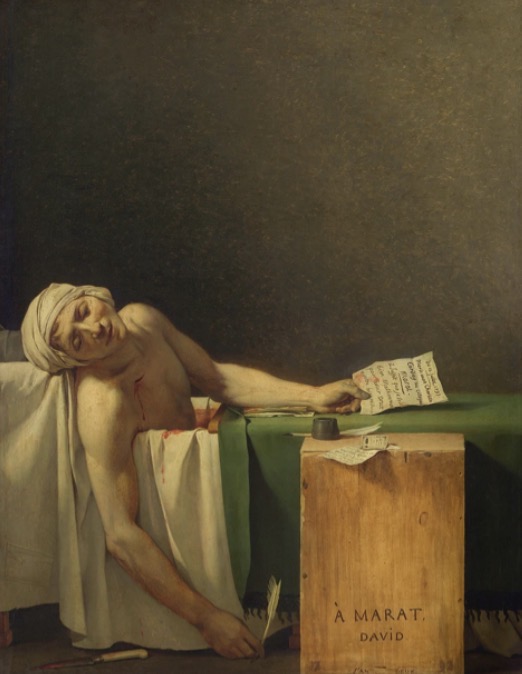
To understand how modern art broke away from classical traditions, one must look back to the fiery crucible of the French Revolution. In Jacques-Louis David’s The Death of Marat (1793), we witness the birth of the secular martyr.
David does not surround the murdered revolutionary leader with weeping angels or divine light. Instead, the background is a void of darkness, filled with muddy light-swallowing shadows. As we see, Marat is entirely alone in his bathtub, his limp arm mimicking the posture of Christ in classical Pieta’ sculptures, yet stripped of any supernatural promise. By placing a political figure into a space traditionally held for the holy, David started a major modern shift: death was no longer an appointment with God, but a final sacrifice made on the altar of human ideology.
- The Quiet Void: Existential Loneliness in the Modern City
As the industrial age progressed, the threat to human life evolved from sudden political execution to the slow, grinding machinery of urban neglect. No artistic era captured this lingering isolation more than Pablo Picasso’s Blue Period, distilled perfectly in The Old Guitarist (1903).
Born out from profound grief, following the suicide of Picasso’s close friend Carlos Casagemas. The painting uses a monochrome palette of cold blues and grays to signify a living death. The elderly, blind street musician is literally and figuratively bent out of shape by a society that has abandoned him. His emaciated body blends into the background, suggesting… that poverty and isolation cause a slow, psychological fading away long before the heart actually stops beating. And so here, modern art captures a uniquely secular horror: the fear of dying completely unnoticed in a crowded world.
- The Infinite Abyss:The Trauma of Mass Catastrophe
If the early 1900s introduced existential loneliness, the mid-century brought industrial mass slaughter. The catastrophic scale of World War Two required an entirely new visual language to process the trauma. Leading Surrealist masters to look inward at the horrors of the subconscious mind. Salvador Dali’s The Face of War (1940) represents the absolute zenith of this collective psychological trauma.
Painted as Dalí fled the onset of World War Two in Europe, the artwork represents a terrifying, disembodied head floating over a barren, dead landscape… The true horror lies in its grim mathematics: inside the eye sockets and mouth of the giant skull are smaller, identical skulls, which in turn contain even smaller skulls, like a Matryoshka doll, which in turn contains even smaller skulls, multiplying in infinity. Dalí ‘s surrealist nightmare perfectly encapsulates the modern realization of total war. Death is no longer an isolated event or a glorious sacrifice, it is an inescapable, compounding cycle of mass destruction that threatens to consume the human consciousness entirely.
- Conclusion: The Ultimate Muse of the Secular Age.
Ultimately, the evolution of death in modern art reflects our own changing relationship with the unknown. By stripping away the comforting and allegories of angels, demons, and peaceful sleep. Modern masters forced viewers to confront mortality in its rarest forms: as a political collateral, as urban isolation, and as eternal trauma. In our increasingly digitized, secular world, these canvases do not merely remind us that we will inevitably die. They serve as a vital and haunting reminder of what it means to be alive, forcing us to find the meaning not in the false promise of the afterlife, but in the fragile, chaotic present. In which, only you decide the way you’ll spend your life.
Edgar Allan Poe: “The boundaries which divide Life from Death are at best shadowy and vague. Who shall say where the one ends, and where the other begins?”
Arian Budeanu 2-DL.